




In the event you’ve ever stood at a canine park watching Huskies trot previous and questioned why they give the impression of being so dramatically completely different from one another, you’re not alone. The Siberian Husky is available in one of many widest coloration ranges of any purebred canine, and the AKC formally acknowledges 9 distinct coat colours for the breed.
Some individuals assume all Huskies are black and white. However the vary really runs from pure white to deep chocolate to a wild wolf-like agouti sample. Add within the 4 potential eye coloration mixtures, and also you’ve received a breed that appears to reinvent itself from canine to canine.
This information covers each AKC-recognized husky coloration, breaks down what’s uncommon versus widespread, offers you a plain-English genetics overview, and explains precisely what these putting eye coloration variations imply.
📋 The 9 AKC-Acknowledged Siberian Husky Colours at a Look
Shade
How Frequent
Standout Trait
Black & White
Very Frequent
Basic sled-dog look
Grey & White
Very Frequent
Ranges from silver to darkish wolf grey
Crimson & White
Frequent
Usually paired with liver nostril and brown eyes
Sable & White
Average
Crimson-tipped black guard hairs
Brown & White
Much less Frequent
Deep chocolate tones
Agouti & White
Uncommon
Wild, banded wolf-like coat
Black
Uncommon
True black with minimal white
Black, Tan & White
Very Uncommon
Tri-color sample uncommon for the breed
White
Unusual
Pure white from masks to tail tip
The 9 AKC-Acknowledged Husky Colours
1. Black and White
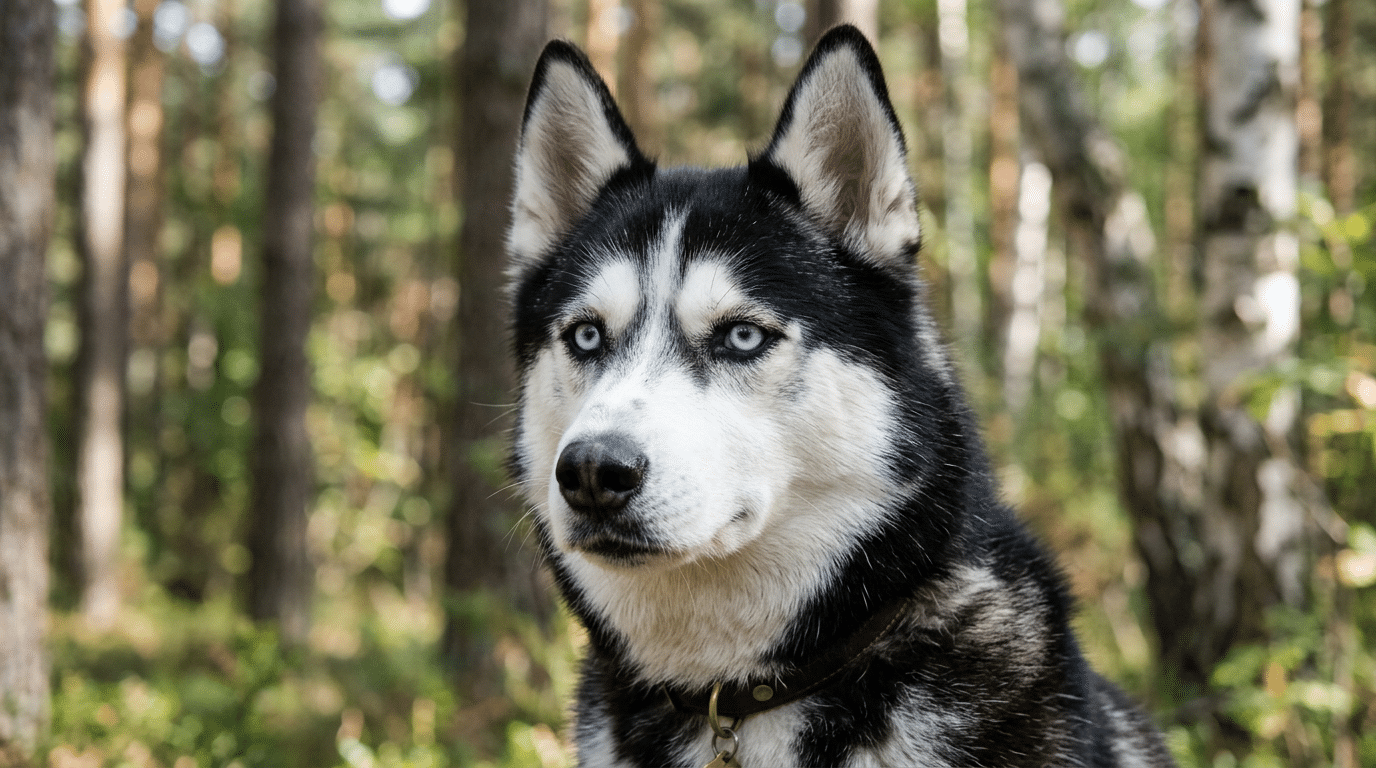
That is most likely the colour most individuals image once they assume “Husky.” The black can vary from jet black to a softer charcoal, often with crisp white markings on the face, chest, and legs. It’s the most typical Husky coloration by a large margin.
Black and white Huskies usually have a black topcoat with white undercoat exhibiting via in spots. That distinction will get much more dramatic once they blow their coat twice a yr. In the event you’ve received one, you already know what meaning on your furnishings and your vacuum cleaner. In the event you’re eager about getting one, try our suggestions for grooming a Husky earlier than you commit.
2. Grey and White
Grey is one other extraordinarily widespread Husky coloration, however “gray” undersells how a lot variation exists right here. A grey Husky is perhaps silver with an nearly metallic sheen, or they might be darkish charcoal grey that appears nearly black in dim gentle. Some appear to be a wolf, which is partly why Huskies get a lot consideration on the road.
The grey coloring comes from a mixture of black and white banding on particular person hairs, plus white on the stomach, masks, and legs. Wolf grey Huskies are particularly fashionable, and actually, it’s simple to see why.
3. Crimson and White
Crimson Huskies flip heads. The coat ranges from a pale strawberry blonde to a deep coppery purple. What makes this coloration stand out much more is that purple and white Huskies often have a liver-colored (brown) nostril and brown or amber eyes as an alternative of the everyday black nostril and blue eyes.
The purple coloration is a recessive trait in Huskies, that means each mother and father want to hold the gene for a pet to indicate it. It’s widespread sufficient that you simply’ll see purple Huskies recurrently, however they’re nonetheless a minority in comparison with black and white or grey and white canine.
4. Sable and White
Sable is without doubt one of the trickier colours to establish as a result of it may well look quite a bit like purple or grey at first look. The secret is the guard hairs: on a sable Husky, every hair has a purple or orange base with a black tip. That banding creates a heat, reddish-brown look with darkish shading throughout the again and withers.
Sable Huskies are generally confused with purple and white Huskies, however for those who look intently on the particular person coat hairs, you’ll see that two-tone banding. Puppies can look fairly reddish at delivery and develop extra noticeable black tipping as they mature.
5. Brown and White
Brown Huskies (generally referred to as chocolate Huskies) are much less widespread. The coat is a wealthy, deep brown with out the purple undertones you’d see in a sable or purple canine. Like purple Huskies, brown and white canine usually include a liver nostril and amber eyes.
This is without doubt one of the less-frequently-seen AKC-recognized colours. Some breeders particularly work to provide chocolate Huskies due to how putting they give the impression of being, particularly with yellow or amber eyes towards that deep brown coat.
6. Agouti and White
Agouti is the wild-type coloration you see in wolves and plenty of different wild canines. Every particular person hair has alternating bands of coloration, often darkish on the tip, lighter within the center, and darkish once more on the base. The result’s a grizzled, gray-brown sample that appears uncooked and primal.
Agouti Huskies are genuinely uncommon. The gene accountable is the “aw” allele on the Agouti locus, and it’s recessive. Most individuals who see an agouti Husky assume it appears to be like extra like a wolf than a home canine. They’re gorgeous, however you received’t see them at each canine park.
7. Black (Stable)
True all-black Huskies are uncommon. Most Huskies labeled “black” have not less than some white on their paws, chest, or face. A genuinely strong black Husky with minimal white markings is uncommon and sometimes turns heads.
Stable black Huskies are likely to have black noses and may carry both blue or brown eyes. Due to the recessive genetics concerned, breeding for strong black is just not one thing most mainstream breeders concentrate on.
8. Black, Tan, and White
This tri-color sample is the rarest of the 9 AKC-recognized Husky colours. Most individuals don’t even know Huskies come on this mixture. It appears to be like considerably much like a German Shepherd’s coloring, with black on the again, tan factors on the face and legs, and white markings.
Tri-color Huskies aren’t produced by any devoted breeding program particularly for this sample. They pop up often and are a genetic curiosity. They’re 100% purebred Siberian Huskies, simply with a gene mixture that hardly ever comes collectively on this breed.
9. White
White Huskies are pure white from nostril to tail tip. No shading, no cream tones, simply white. They’re not albino canine. White Huskies usually have darkish pigmentation on their nostril and round their eyes, and so they can have blue, brown, or bi-eyed eye coloration identical to another Husky.
Pure white is a recessive coloration that requires the suitable mixture of genes. White Huskies are unusual however not extraordinarily uncommon. They’re completely putting, particularly with blue eyes, and so they {photograph} like a dream. Truthful warning: in addition they present dust instantly.
Husky Eye Colours: The 4 Prospects
Coat coloration will get a lot of the consideration, however Husky eye coloration is arguably much more distinctive. The breed is one in every of just a few that recurrently produces blue eyes in adults, and the vary of eye coloration mixtures is genuinely distinctive.
👁️ Husky Eye Shade Choices
Eye Sort
Description
Notes
Blue
Pale to vivid icy blue
Most iconic Husky eye coloration; not linked to deafness on this breed
Brown
Amber to darkish brown
Frequent in purple and brown coat canine; heat and expressive
Bi-eyed
One blue, one brown eye
Utterly regular; brought on by uneven pigment distribution
Parti-eyed
Two colours inside one eye
Patches of blue and brown in the identical iris; additionally referred to as “marbled”
Blue Eyes
Blue eyes in Huskies are brought on by a selected genetic variant close to the ALX4 gene on chromosome 18. That is completely different from how merle breeds get blue eyes, and it has no connection to deafness (a priority with another blue-eyed breeds). Blue eyes seem in Huskies of all coat colours, although they’re mostly related to black and white or grey and white canine. Eye coloration ranges from pale, nearly white-blue to a deep, vivid sapphire.
Brown Eyes
Brown eyes in Huskies vary from gentle amber to darkish chocolate. They’re most continuously seen in purple, sable, and brown-coated Huskies, although any coat coloration can produce a brown-eyed canine. Brown-eyed Huskies usually look particularly heat and expressive. They’re simply as wholesome as blue-eyed canine; some individuals simply assume blue equals “purebred” and brown means in any other case, which isn’t true in any respect.
Bi-eyed
Bi-eyed Huskies have one blue eye and one brown eye. That is thought-about utterly regular within the breed and is accepted within the present ring. It occurs when the genetic elements controlling eye pigmentation don’t develop symmetrically. It’s not a well being concern. If something, bi-eyed Huskies get much more stares on the canine park than their single-colored counterparts. Try our article on canine breeds with probably the most putting eye colours to see how Huskies stack up towards different remarkable-looking canine.
Parti-eyed
Parti-eyed is the rarest of the 4 eye varieties. This implies a single iris accommodates patches of each blue and brown, making a swirled or sectored look inside one eye. Some individuals name it “marbled.” A parti-eyed Husky might need each eyes parti-colored, or only one, or a mix of a solid-color eye on one facet and parti on the opposite. It’s putting, uncommon, and utterly effective from a well being standpoint.
Husky Shade Genetics: The Easy Model
You don’t want a biology diploma to grasp the fundamentals of how Husky coat coloration works. Right here’s a fast overview.
All canine coat colours are managed by pigments: eumelanin (which produces black and brown tones) and phaeomelanin (which produces purple and yellow tones). A number of gene loci management how these pigments are expressed, diluted, or patterned.
In Huskies, crucial loci are:
A locus (Agouti): Controls sample. The “aw” allele produces agouti, “at” produces tan factors (accountable for black/tan/white), and “a” produces strong black. “Ay” would produce sable-type patterns.
B locus: Controls whether or not eumelanin is black (B) or brown (b). A canine with two copies of “b” produces chocolate/brown as an alternative of black.
E locus: Controls whether or not any black pigment is expressed in any respect. “ee” canine are purple or cream no matter different genes.
Dilution locus (D): Can dilute black to blue-gray and purple to cream, although that is much less widespread in Huskies.
The white on most Huskies comes from the S (recognizing) locus, which controls the place white patches seem on the coat. The quantity of white can fluctuate fairly a bit even inside the similar litter.
Eye coloration in Huskies doesn’t comply with the identical pathway as coat coloration. The ALX4 gene variant related to blue eyes in Huskies is impartial of the coat coloration genetics, which is why you will get a purple and white Husky with blue eyes or a white Husky with brown eyes.
Uncommon vs. Frequent: Breaking It Down
In the event you’re looking for a selected coloration, it helps to know what you’re realistically more likely to encounter from a breeder.
Most typical: Black and white and grey and white are by far probably the most continuously produced Husky colours. In the event you go to a accountable breeder or a Husky rescue, these two will make up nearly all of out there canine.
Frequent however not the bulk: Crimson and white is a well-liked coloration that’s recurrently out there from breeders who work with it. Sable is barely much less widespread however nonetheless not exhausting to search out for those who search for it.
Much less widespread: White Huskies and brown/chocolate Huskies exist however require particular breeding pairs. Count on to attend a bit longer if that is your desire.
Genuinely uncommon: Agouti, strong black, and particularly black/tan/white Huskies are unusual. You received’t discover these by calling the primary breeder you discover. Devoted breeders with particular bloodlines could produce them, nevertheless it usually takes time and endurance to discover a pet in these colours.
One factor value noting: coloration shouldn’t be the primary purpose you select a Husky. These canine are energetic, vocal, escape-artist-level intelligent, and wish severe train. An attractive agouti Husky with no correct outlet will redecorate your home. In the event you’re researching the breed, check out canine breeds much like Huskies if you would like the look however are unsure whether or not the Husky’s depth is correct on your way of life.
What About Coat Colours Not on the AKC Listing?
You’ll generally see Huskies described as “isabella,” “dilute,” “merle,” or “blue.” Right here’s the reality about these.
Blue dilute Huskies: These have a diluted black coat that appears grayish-blue. Whereas this may occur genetically, it’s not a separate AKC-recognized coloration class. The colour would nonetheless be registered underneath grey or black.
Merle Huskies: There isn’t a merle gene in purebred Siberian Huskies. Any Husky labeled “merle” is both a combination or a misidentified agouti or parti-colored canine. Merle requires a selected genetic mutation that isn’t current within the breed’s gene pool. If somebody is promoting “merle Huskies,” that must be a purple flag about their breeding practices.
Piebald: Some white-heavy Huskies are described as piebald, however the breed commonplace simply considers this a part of the traditional white recognizing variation.
The underside line: follow the 9 AKC-recognized colours for those who’re working with a good breeder, and be cautious of anybody advertising and marketing uncommon “rare” colours at a major worth premium. Rarity in coloration ought to by no means come on the expense of well being testing and moral breeding practices.
Does Shade Have an effect on Well being or Temperament?
Quick reply: no. A white Husky isn’t calmer than a black and white one. An agouti Husky isn’t extra “wolf-like” in habits than a purple one. Coat coloration in Huskies has basically no relationship to temperament or well being.
There’s one exception value mentioning: the “double dilute” gene mixture (dd) that produces excessive coloration dilution can generally be related to coloration dilution alopecia (CDA), a pores and skin and coat situation. That is uncommon in Huskies and extra generally mentioned in breeds like Dobermans and blue Nice Danes. Commonplace Husky coat colours don’t carry this threat.
What does have an effect on a Husky’s well being and temperament is genetics, socialization, weight-reduction plan, and train. In the event you deliver dwelling a Husky pet, their weight-reduction plan issues as a lot as the rest. Check out the entire Husky feeding information to get their diet proper from day one. And for those who’re within the early levels of pet prep, the Husky pet purchasing guidelines covers every thing you want earlier than bringing one dwelling.
Husky Colours by Age: What Modifications Over Time
Husky coat coloration can shift fairly a bit from puppyhood to maturity, and it doesn’t all the time cease there.
Sable puppies are an excellent instance: they’re usually born trying fairly purple or orange and develop the darker black tipping on their guard hairs over the primary yr. A pet that appears largely purple at eight weeks may present apparent sable patterning by six months.
White Huskies could be difficult to establish at delivery as a result of cream-colored puppies generally clear to white as they mature. A really white Husky will often be evident by a number of months previous.
Grey Huskies generally get lighter or develop completely different shading as they age. Senior Huskies usually develop white or grey across the muzzle no matter their base coat coloration, which simply provides to their already distinguished look.
In case your Husky’s coat appears to be altering in texture moderately than coloration (thinning, shedding luster, or exhibiting patchy progress), that’s value a vet dialog. Coat modifications can generally sign dietary gaps or well being points. Maintaining with Husky well being dietary supplements may also help keep coat high quality year-round.
Grooming Wants by Coat Shade
Right here’s the factor no one tells you earlier than getting a Husky: lighter coat colours (white, cream, gentle grey) present dust instantly however are additionally a lot simpler to spot-clean. Darkish coat colours (black and white, darkish grey) conceal mud surprisingly nicely however present lighter particles like mud and pet dander extra clearly.
The grooming calls for don’t actually differ primarily based on coloration, although. Each Husky has a dense double coat that wants common brushing year-round and severe consideration throughout the two annual blow-coat seasons. Our Husky grooming information walks via the instruments and strategies that truly make a distinction. White Huskies might have occasional bathing extra usually in the event that they spend time open air, since their coat exhibits grime sooner than dark-coated canine.
For any Husky, particularly pups, ensuring diet is dialed in makes an actual distinction in coat high quality. The fitting meals helps hold the double coat wholesome, shiny, and shed-ready. Try our information to the very best pet canine meals for Huskies for those who’ve received a younger one at dwelling.
Often Requested Questions About Husky Colours
What’s the rarest Husky coloration?
The rarest of the 9 AKC-recognized Husky colours is the black, tan, and white tri-color sample. Agouti and strong black are additionally genuinely uncommon. Amongst eye colours, parti-eyed (two colours in a single iris) is the least generally seen mixture.
Can a Husky be merle?
No. Purebred Siberian Huskies don’t carry the merle gene. If a canine is labeled a “merle Husky,” it’s nearly definitely a combined breed or the vendor is misidentifying an agouti or parti-colored coat. Merle Huskies don’t exist inside the purebred gene pool.
Do all Huskies have blue eyes?
No. Whereas blue eyes are iconic in Siberian Huskies, the breed generally produces brown, amber, bi-eyed (one in every of every), and parti-eyed (two colours in a single iris) people as nicely. Brown eyes are particularly widespread in purple and chocolate-coated Huskies. All eye colours are equally wholesome and accepted by the AKC breed commonplace.
What’s an agouti Husky?
An agouti Husky has particular person hairs with alternating bands of darkish and light-weight coloration, producing a wild, wolf-like grayish-brown look. It’s the oldest, most primitive coat sample in home canine and one of many rarest coloration expressions in Siberian Huskies. Each mother and father should carry the recessive agouti allele for a pet to show this coloring.
Does Husky coat coloration have an effect on temperament?
No. Coat coloration has no relationship to a Husky’s temperament, power degree, trainability, or well being. All Siberian Huskies, no matter coloration, share the identical breed traits: excessive power, sturdy prey drive, vocal tendencies, and a necessity for important day by day train and psychological stimulation.
What number of colours does the AKC acknowledge for Siberian Huskies?
The AKC acknowledges 9 commonplace colours for the Siberian Husky: black and white, grey and white, purple and white, sable and white, brown and white, agouti and white, black, black/tan/white, and white. The breed commonplace notes that each one colours from black to pure white are acceptable.
Can Husky coat coloration change as they age?
Sure, particularly within the first yr of life. Sable Huskies usually look fairly purple as puppies earlier than darker tipping develops. White puppies could seem cream at delivery and clear to white by a number of months previous. Most grownup Huskies’ colours stabilize after their first coat however can lighten barely with age, and senior canine usually develop white muzzle hair no matter base coat coloration.
What does bi-eyed imply in a Husky?
Bi-eyed means the Husky has one blue eye and one brown eye. This can be a pure and accepted trait within the breed, brought on by asymmetrical pigment distribution throughout growth. It’s utterly wholesome and allowed in AKC conformation exhibits. Parti-eyed, the same however completely different trait, means a single iris accommodates each blue and brown coloring.

Backside Line
The Siberian Husky is without doubt one of the most visually various purebreds on the market. 9 AKC-recognized coat colours, 4 distinct eye coloration mixtures, and near-infinite variation in markings and shading imply you possibly can have 20 Huskies in a room and no two would look fairly the identical.
Black and white and grey and white are your commonest outcomes. Agouti, strong black, and tri-color are your genuinely uncommon finds. Crimson and white is an attractive center floor. White Huskies are gorgeous however present each speck of dust they encounter.
Blue eyes are iconic however not the one possibility. Bi-eyed canine are utterly wholesome. Parti-eyed Huskies exist and are wonderful. None of it has something to do with well being, temperament, or trainability.
No matter coloration attracts you to this breed, know what you’re signing up for: a high-energy, vocal, escape-prone, fur-tornado of a canine who can be your shadow, your leisure, and sometimes your nemesis. Value each little bit of it, actually.
iHeartDogs is reader supported. A number of the hyperlinks beneath could also be paid affiliate hyperlinks, the place we obtain a small fee on a product at no further value to you.