




Similar to with people, not all canine are naturally good communicators. Early socialization might help a younger canine develop good communication abilities. Credit score: redstallion | Getty Photos
Watch two canine interacting at a canine park and also you may not suppose a lot of it; a fast sniff, a wagging tail and so they’re off! What you’re really seeing, although, is a complicated change of data occurring throughout a number of channels on the similar time. Canine talk via physique language, facial expressions, vocalizations, and scent and so they do it continuously; with one another, with us, and with the setting round them.
Understanding how canine talk with one another doesn’t simply make you a extra knowledgeable care giver. It helps make you a greater advocate on your canine, as you’ll be able to higher acknowledge when an interplay goes nicely, when it isn’t, and when it’s time to intervene.
Canine Physique Language: The Main Channel
The place of a canine’s physique, the best way they maintain their tail, the angle of their ears, and the fluidity of their motion all carry which means. Skilled canine learn these indicators in actual time, making fixed changes in response. Let’s take a look at some completely different points of physique language and what they imply:
Posture and motion—A canine who’s assured and comfy will carry themselves in a relaxed and fluid approach with their weight evenly distributed and their motion unfastened and free. Whereas an assertive or aroused canine would possibly shift their weight ahead and stand tall, making themselves seem bigger. A canine who’s uncertain will do the alternative and decrease their physique, shifting their weight backwards and even roll onto their facet to sign they pose no menace.
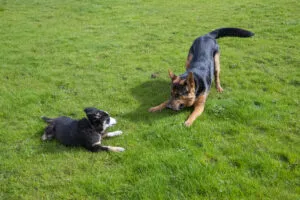

The play bow—Entrance finish down, rear find yourself is a universally understood sign within the canine behavioral repertoire. It’s an invite to play and likewise serves as a reset when play turns into too intense.
Tail place and motion—A tail held excessive and wagging quickly indicators arousal and confidence. However a wagging tail doesn’t all the time imply pleasant. A tail held low or tucked is an indication of concern or uncertainty. Analysis has found {that a} unfastened, mid-height, loping tail wag is normally a superb signal. The path additionally issues! A tail wagged to the correct is related to optimistic emotional states whereas a left bias tail wag is related to detrimental emotional states and canine seem to detect this as nicely.
Ear place—Ears carried ahead sign alertness or curiosity whereas ears flattened in opposition to the pinnacle present concern, appeasement, or submission. Ears which are held barely again or loosely to the facet point out a relaxed canine. Ear place does range relying on morphology (floppy ears vs. pricked ears).
Canine Calming Alerts
Calming indicators are a selected class of canine physique language first described by Norwegian canine coach Turid Rugaas. These are behaviors used to speak peaceable intent and to de-escalate pressure. They embody yawning, lip-licking, turning the pinnacle or physique away, blinking slowly, sniffing the bottom, and shifting in an arc reasonably than a straight line in direction of one other canine.
Calming indicators are usually not random behaviors. They’re intentional communication and sign the canine will not be a menace or that they’re uncomfortable. When one other canine responds to calming indicators appropriately by softening their very own physique language or redirecting their method, the interplay sometimes stays protected. If calming indicators are ignored, pressure can simply escalate.
Understanding Canine Facial Expressions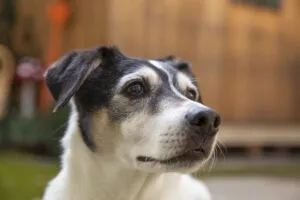
Canine have surprisingly expressive faces, particularly their eyes. Comfortable eyes (relaxed, barely squinting), sign consolation and leisure. Whereas a tough stare the place the whites of the eyes are seen (additionally known as “whale eye”), is a warning. It’s one of many clearest indicators a canine is feeling threatening.
The mouth additionally tells a narrative. A relaxed, barely open mouth with a lolling tongue reveals a canine is calm and comfy. A good, closed mouth is an indication of a canine who’s concentrating or assessing the setting. The submissive grin the place the lips are pulled again is regularly misinterpret as aggression nevertheless in actuality it’s appeasement.
Deciphering Canine Vocalizations
Canine can vocalize in just a few alternative ways and every means one thing completely different:
Barking is very context dependent and might sign every little thing from alarm (sharp and fast) to a want to play (intermittent and excessive pitched).
Growling is communication, not aggression. A canine who growls is saying they’re uncomfortable and wish area. Punishing a growl doesn’t resolve the discomfort and might train the canine to skip the warning and go straight to a chew as an alternative.
Whining indicators misery, frustration, or the need for consideration.
Howling is usually a response to sounds akin to a siren or different canine howling. Some canine would possibly howl when experiencing separation from their caregiver.
How Canine Use Scent to Talk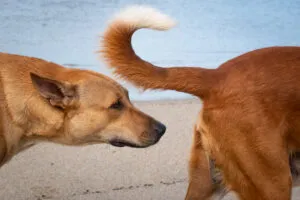
Canine expertise their world main via their sense of odor. Accordingly, a good portion of their communication with different canine happens via olfaction and contains:
Urine marking—The data contained inside a canine’s urine contains their intercourse, reproductive standing, and well being. When a canine pauses to analyze each tree or bush on a stroll, they’re studying their native bulletin board of data left by different canine within the neighborhood
Anal glands—When canine greet one another nostril to rear, they’re exchanging detailed chemical details about who this canine is, how they’re feeling, and what they’ve just lately eaten and this info gathering occurs in seconds!
Pheromones—Pheromones are chemical indicators (detected by the vomeronasal organ) that function beneath the extent of acutely aware consciousness and affect social conduct in methods we’re nonetheless studying about.
When Canine Communication Breaks Down
Not all canine are proficient communicators, particularly those that missed important socialization home windows throughout puppyhood. These canine usually wrestle to learn and reply to indicators precisely. A canine who was remoted throughout this time might not acknowledge a play bow as an invite or understand how to answer appeasement indicators from one other canine.
Bodily alterations akin to docked ears and tails may also have an effect on communication, making it more durable for different canine to learn them.
Communication may also break down when early indicators are ignored and a canine is pushed previous their restrict. A canine who has yawned, seemed away, licked their lips, and tried to maneuver away has run out of choices and should have to get louder and more durable to overlook: a growl, a snap, or a chew. Typically the warning indicators have been there. They have been simply not seen or ignored.
What House owners Can Do: Serving to Your Canine Talk Higher
Crucial factor an proprietor can do is to be taught to learn and reply to your canine’s indicators. In the event that they’re yawning repeatedly throughout a greeting, turning away, or making an attempt to maneuver away, they’re speaking clearly. Holding them in place or encouraging the opposite canine to maintain approaching teaches your canine that their communication doesn’t work, which can doubtless trigger concern, frustration, and anxiousness.
Give canine time and area to speak on their very own phrases and be able to intervene if wanted. Quick optimistic interactions are far more helpful than extended interactions that finish badly.
In case your canine constantly struggles to speak with different canine, it’s value consulting a professional behavioral skilled. These patterns might not resolve on their very own and early intervention could make an enormous distinction.
Supporting your canine’s social growth means prioritizing high quality over amount. A handful of optimistic interactions with well-matched canine does extra for a canine’s social confidence than dozens of chaotic ones at a busy canine park.
How Canine Talk
Canine are refined communicators. The extra fluent you turn into at studying your canine’s physique language the higher geared up you’re to help them of their interactions with different canine and of their relationship with you.
References
Mariti, C., Falaschi, C., Zilocchi, M., Carlone, B., & Gazzano, A. (2014). Evaluation of calming indicators in home canine: Are they indicators and are they calming?: 3. Journal of Veterinary Habits: Scientific Purposes and Analysis, 9(6), e1-e2.
Siniscalchi, M., Lusito, R., Vallortigara, G., & Quaranta, A. (2013). Seeing left-or right-asymmetric tail wagging produces completely different emotional responses in canine. Present Biology, 23(22), 2279-2282.
Quaranta, A., d’Ingeo, S., Minunno, M., Straziota, V., Nolè, M., Ventriglia, G., … & Siniscalchi, M. (2025). Decoding canine communication via the physiology and conduct of urine marking. Scientific Reviews.

